Tuesday, April 9, 2013

Remember the Mustard Seed


Last spring the Diocese of Western New York gave each Deanery a mustard seed in the form of $250.  We were told to take the money, do something that would make the world better and report back to Convention in October.

As you may remember our deanery (Eastern Erie) and the Northern Erie Deanery decided to work together and that the way we were going to make the world better was to try to spread the word that, contrary to what people might have heard, God Loves Us, no exceptions.

We put up a blog with a variety of resources and people telling the stories about how they came to believe that God loved them and that God loved everyone - no exceptions.

Here's the blog.  We sent out 1,000 postcards to tell people about the blog.  We printed some banners to use at events, parades etc... and, oh yes, we started a facebook page.  Here's the facebook page.
We spent about $100 on facebook advertising.

We were hoping that people might notice, but more importantly that people would begin to believe that God loved them - no excpetions.

Well here's an update.  The facebook page has gone viral.

In the week of March 28 to April 3 - the facebook page had a reach of 15,795,050.  Yes you read that right over 15 million people were reached.  And 22,005 were "talking about this"  that is facebook speak for engaging the content - reposting it, commenting on it etc...

This week March 30 to April 5 - the reach is down a little to 13,386,832 - still not bad - over 13 million people.  But the exciting thing is the "talking about this" figure.  562,688 people were engaging with the content this week.  That's right over half a million people. 

To give you a comparison - in 2011 the Average Sunday Attendance of the Episcopal Church - that is every church in The Episcopal Church in the United States, the American Churches in Europe, Haiti, Venezuela etc... was 698,376. 

Jesus said, "The kingdom of heaven is like a mustard seed that someone took and sowed in his field; it is the smallest of all the seeds, but when it has grown it is the greatest of shrubs and becomes a tree, so that the birds of the air come and make nests in its branches."  Matthew 13:31-32

Thursday, March 21, 2013

Flunking Sainthood - Hospitality and Vegetarianism

It struck me this week how much of many of these spiritual disciplines involve paying attention to the people and things around you.

This week for example - the core of the discipline of hospitality is thinking about your guest and what will make your guest feel like they belong in your home, or your club or your church.  That is the basic definition of hospitality - making the guest feel at home - like they belong here.

The second chapter this week seems to me to revolve around thinking about where our food comes from - what impact are we having on ourselves and on the world around us by eating in the ways that we eat.

I wonder what it would be like if we tried to pay attention to the impact that we are having on the people and the world around us all the time - would we make different choices - would it draw us closer to God or to each other?

Thursday, March 14, 2013

Flunking Sainthood - Sabbath and Gratitude

The conversations about Sabbath keeping and what a Sabbath is and how we might keep the Sabbath in our world today have been really interesting.  But I've been pondering this week the concept of Thanksgiving.

It's easy for me to make a long list of things that I'm thankful for.  It's harder to take the time to remember to make the list - but that's another story.  But as I look at the list of things I'm thankful for they are all good things.  I can imagine you saying - well of course- what else would you be thankful for.

But I've been thinking about St. Paul's direction to Christians - "rejoice always, pray constantly, give thanks in all circumstances"

It's that giving thanks in all circumstances that I've been thinking about.  How do we, how do I give thanks for things I don't like and didn't want.  How do I give thanks for the bad things?

Thursday, March 7, 2013

Flunking Sainthood - week 3

I've been thinking about the boundary between needs and wants - and when it is that things make the jump from one to the other.

We can all agree on the basics - I think - food, shelter, water, clothing.  Those are all needs for everybody at all times and in all places.

But it gets more difficult as we think about specific cases.  For example, it would be hard to argue that some kind of a telephone is not a need in 21st century America.  While a car may not be a need in New York City or Chicago - it kind of is in Clarence.  I guess it's technically possible to get around without one - but it's so difficult as to be unrealistic.

So what about voicemail? a computer? a t.v.? a radio?  Which of those things are now, in effect needs?  When does something make the jump from a want to a need?  What are the criteria?

Thursday, February 28, 2013

Flunking Sainthood - Week 2

The two chapters we were looking at this week were Finding God in Daily Things and Lectio Divina.

The first practice is centered around doing everything that you can with the intention of finding God in it.  Find God in making dinner, find God in baking bread, find God in making the beds, find God in hanging out the wash.  You get the idea.  Pay attention to what you are doing and do everything to the glory of God.

The second practice is the reading of the Bible as prayer itself.  Done intentionally over time it is possible to pray a small passage of scripture for a long time.  We don't read like this too much any more- but with practice it can open whole new meanings from even familiar passages.

One of the things that struck me this week is that these - and all the other spiritual practices - seem to be perfectly designed to help people find God in the midst of life as it was lived for most of human history up to about 70 years ago.

Most people spent most of their time on the daily tasks of making food and clothing and shelter and getting fuel to make food and clothing and shelter.  For most people, even today for most people on earth, life has limited choices, the same tasks every day, and lived close to the edge of not having enough.  In those circumstances the "traditional" spiritual disciplines serve to use the reality of daily life as a way to draw us closer to God.  In a way they point to the presence of God in the midst of daily life.

For most of us that is no longer what life is like.  Our lives are composed of abundance, endless choices, global connectedness and the constant presence of others either virtually or in reality or both.  What would spiritual practices would point the way to the presence of God in the midst of our daily life.

Thursday, February 21, 2013

Flunking Sainthood - part one

Along with the rest of the Diocese of Western New York, St. Paul's is reading Flunking Sainthood by Jana Reiss.

The book is the memior of the journey of the author as she tries a different spiritual practice each month.

The first chapter lays out the premise - that a different practice will be tried each month, that she will look at some of the writing about that practice and that she will blog about it.

I was really struck by her reflection on the scene from Exodus where the people of Israel are given the 10 commandments and reply "All that you have said we will do and hear" and that through the centuries the rabbis have taught that we can't really hear God until we have tried to do what God calls us to.

I've been really reflecting on that - words take on more and deeper meanings where there is experiance that connects with them.  I can listen to someone talk about the Grand Canyon, for example, but having travelled down to the bottom myself, I hear the story differently.  It's one of the reasons I like our cycle of readings.  When the Gospel reading from three years ago comes up again, I hear it differently because I've had different experiances since I preached on it the last time.

The first month of her practice is February and she picks fasting. 

One of the things I remember being taught about fasting is that one of the original purposes of fasting in the Christian world was to try to live like the poor.  To eat what the poor ate.  That got me thinking about what the poor eat in our world.  It isn't fish anymore, it certainly isn't vegetables, at any rate fresh vegetables.  Actually the poor in our world tend to eat canned and processed food because it's what available and what they can afford.  

I wonder what a fast would be like if we tried to eat like the poor today.

Thursday, February 14, 2013

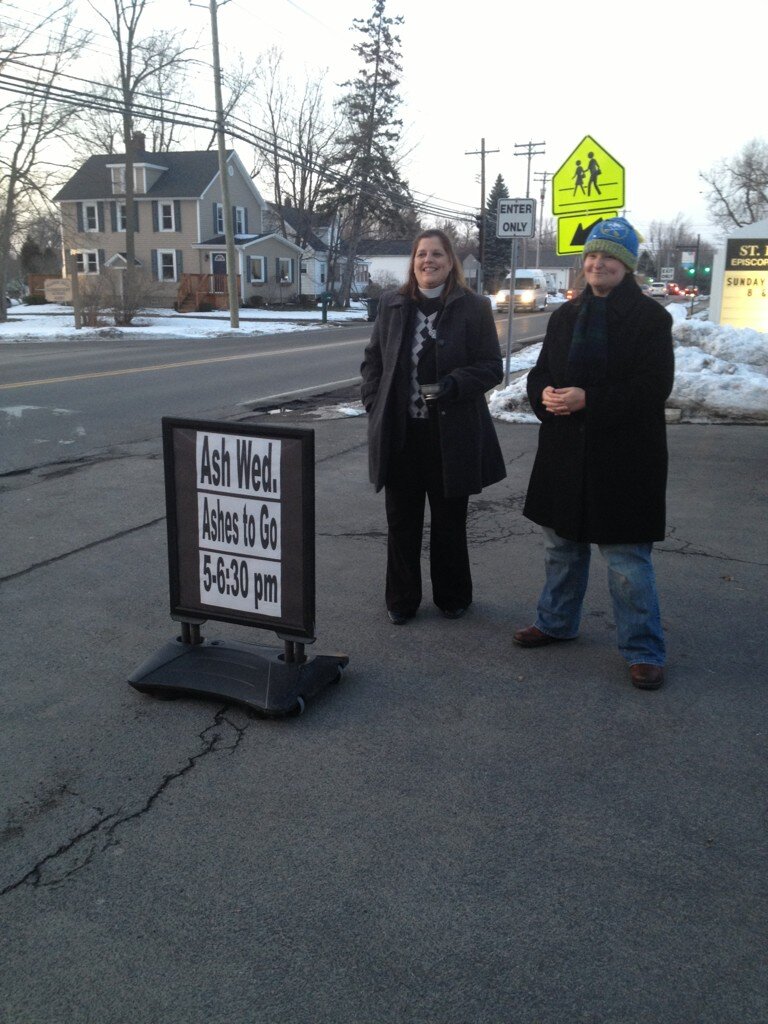
Ashes to Go


This is the Rev. Sare Anuszkiewicz and I out in front of the church yesterday during our Ashes to Go.

We had 70 people drive in for ashes.  A few were our own parishioners who couldn't make it to church but more than 60 were people who weren't a part of St. Paul's.  We prayed with them, imposed ashes and gave them our Lent brochure and some prayers they could say at home.

My favorite story was the mother who pulled in with her teenage daughter, then about an hour later came back with her 4 or 5 year old.  They had gotten home and the little girl was upset that she didn't have ashes too. 

I think next year we will add morning hours as well - one of the things I learned is that I need a couple of people to help direct traffic, greet people and hand out the prayers.  So look for your chance to help next year.