Monday, June 25, 2012

What is a mustard seed?


It's a small seed that grows into a big plant. The Diocese has given each deanery a small amount of money and asked us to do big things with it.

Our deanery and Northern Erie have gone together - we are focusing on getting the word out that "God loves you - no exceptions"

As a part of this we've started a website no-exceptions.org where we can spread the word that God loves you - no exceptions.

Check it out. A big part of it is going to be interviews with people telling how God loves us.

We need lots of people to answer the following questions:

1. What is your dream for the world?

2. When did you know that God loves you?

3. When did you know that God loves everyone - no exceptions?

E-mail your answers to Pastor Vicki at paulsrector@gmail.com or let her know that you are willing to be interviewed on video and we'll get your story up there too. The more people who participate the more people we'll be able to reach, the bigger the mustard seed will grow.


Thursday, May 10, 2012

Congratulations

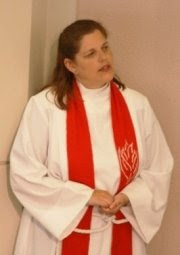
Bishop Franklin confirmed eight young people when he visited us last Sunday.

Here's a picture of one of the confirmations.

The Bishop included in his sermon some things from the statements of faith that our confirmands had written.

Congratulations to the confirmands, their families and to all of the people of St. Paul's who were a part of helping them grow and explore their faith.

In baptism we promise to do all in our power to suppor the person being baptized in his or her life in Christ.  This is one part of what that means.

Tuesday, April 17, 2012

Joy


I've been thinking about joy this week.  One of the hallmarks of Easter is supposed to be joy.  Joy that Christ has risen, joy that we no longer need to fear death, joy in the renewal of life, joy.

It seems to me that it is hard for us to hold on to joy.  We so rarely seem to find it.

I was thinking about the little kids running around at the Easter Egg hunt on Holy Saturday

There is little to match the pure joy of small children running around in the sun.  I wish I could capture a little of that kind of joy more often. 

So, maybe for the Great 50 days of Easter we could seek a little more joy in our daily lives.

Sunday, April 8, 2012

Happy Easter

Welcome to the great 50 days - the days that begin with Easter and end with Pentecost when we celebrate with joy the resurrection of Jesus Christ and his victory over death.

It is a time for joy, and family and to remember those we love and those who love us and to look for joy and love in all parts of our lives.

Almighty God, who through your only-begotten Son Jesus Christ overcame death and opened to us the gate of everlasting life:  Grant that I, who celebrate with joy the day of the Lord's resurrection, may be raised from the death of sin by your life-giving Spirit; through Jesus Christ our Lord, who lives and reigns with you and the Holy Spirit, one God, now and for ever.  Amen.

Saturday, March 24, 2012

Lent Week 5

A reading on Christian charity from A Serious Call to a Devout and Holy Life by William Law

Miranda (the sister of Flavia) is a sober, reasonable Christian:  as soon as she was mistress of her time and fortune, it was her first thought how she might best fulfill everything that God required of her in the use of them, and how she might make best and happiest use of this short life.  She depends upon the truth of what our blessed Lord has said, that there is but “One thing needful,” and therefore makes her whole life but one continual labor after it.  She has but one reason for doing or not doing, for liking or not liking anything, and that is the will of God.  She is not so weak as to pretend to add what is called the fine lady to the true Christian; Miranda thinks too well to be taken with the sound of such silly words; she has renounced the world to follow Christ in the exercise of humility, charity, devotion, abstinence, and heavenly affections.

Miranda does not divide her duty between God, her neighbor, and herself; but she considers all as due to God, and so does everything in God’s Name, and for God’s sake.  This makes her consider her fortune as the gift of God, that is to be used, as everything is that belongs to God, for the wise and reasonable ends of a Christian and holy life.  Her fortune therefore is divided between herself and several other poor people, and she has only her part of relief from it.  She thinks it the same folly to indulge herself in needless, vain expenses, as to give to other people to spend in the same way.  Therefore as she will not give a poor man money to go see a puppet-show, neither will she allow herself any to spend in the same manner; thinking it very proper to be as wise herself as she expects poor men should be.  For it is a folly and a crime in a poor man, says Miranda, to waste what is given him in foolish trifles, while he wants meat, drink, and clothes.

It may be, says Miranda, that I may often given to those that do not deserve it, or that will make an ill use of my alms.  But what then?  Is not this the very method of Divine goodness?  Does not God make his “sun to rise on the evil and on the good”?  Is not this the very goodness that is recommended to us in Scripture, that, by imitating of it, we may be children of our Father in Heaven, who “sends rain on the just and on the unjust”?  And shall I withhold a little money, or food, from my fellow-creatures, for fear they should not be good enough to receive it of me?  Do I beg of God to deal with me, not according to my merit, but according to God’s own great goodness; and shall I be so absurd as to withhold my charity from a poor brother or sister, because they may perhaps not deserve it?  Shall I use a measure towards them, which I pray God never to use towards me?

You will perhaps say, that by this means I encourage people to be beggars.  But the same thoughtless objection may be made against all kinds of charities, for they may encourage people to depend upon them.  The same may be said against clothing the naked, or giving medicines to the sick; for that may encourage people to neglect themselves, and be careless of their health.  But when the love of God swells in you, when it has enlarged your heart, and filled you with bowels of mercy and compassion, you will make no more such objections as these.

This is the spirit, and this is the life, of the devout Miranda; and if she lives ten years longer, she will have spent sixty hundred pounds in charity, for that which she allows herself, may fairly be reckoned amongst her alms.

When she dies, she must shine among Apostles, and saints, and martyrs; she must stand among the first servants of God, and be glorious among those that have fought the good fight, and finished their course with joy.

She considers all as due to God.

On what basis do we give?  How do we balance stewardship & alms?  What is the difference between personal and impersonal almsgiving.

From A Time To Turn by Christopher Webber

Saturday, March 17, 2012

Lent Week 4

A reading from The Spirit of Prayer by William Law

The Spirit of Prayer is a pressing forth of the soul out of the earthly life.  It is a stretching with all its desire after the life of God.  It is a leaving, as far as it can, all its own spirit to receive a Spirit from above, to be one life, one love, one spirit with Christ in God.  This prayer, which is an emptying itself of all its own lusts and natural tempers, and an opening itself for the light and love of God to enter into it, it’s the prayer in the Name of Christ, to which nothing is denied for the love which God bears to the soul.  His eternal, never-ceasing desire to enter into it, to dwell in it, an open the birth of his Holy Word and Spirit in it stays not longer than till the door of the heart opens for him.  For nothing does, or can keep God out of the soul, or hinder his holy union with it, but the desire of the heart turned from him.  And the reason of it is this.  It is because the life of the soul is in itself nothing else but a working will and therefore wherever the will works or goes, there, and there only, the soul lives whether it be in God or the creature.

Nothing does or can go with us into Heaven.  Nothing follows us into Hell, but that in which the will dwelt, with which it was fed, nourished and clothed in this life.  And this is to be noted well, that death can make no alteration of this state of the will.  It only takes off the outward, worldly covering of flesh and blood, and forces the soul to see and feel and know what a life, what a state, food, body and habitation, its own working will has brought forth in it.    

Tell me, is there anything in life that deserves a thought, but how to keep this working of our will in a right state, and to get that purity of heart which alone can see and know and find and possess God?  Is there anything so frightful as this worldly spirit which turns the soul from God, makes it a House of Darkness, and feeds it with the food of time at the expense of all of the riches of eternity?  On the other hand, what can be so desirable a good as the Spirit of Prayer, which empties the soul of all its own evil, separates death and darkness from it, leaves Self, time and the world, and becomes one life, one light, one love, one spirit with Christ and God and Heaven.

Think, my Friends, of these things with something more than thoughts.  Let your hungry souls eat of the nourishment of them as a bread of Heaven, and desire only to live that with all the working of your wills and the whole spirit of your minds, you may live and die united to God.

Prayer is an opening to light and love
How do you remember being taught to pray?  What is your experience with prayer?  How has your prayer life changed over time?

From A Time To Turn by Christopher Webber

William Law (1686-1761) was one of those who refused to take the oath of loyalty to George I and therefore was forced to live outside the established church.  His Serious Call to a Devout and Holy Life nevertheless became one of the most widely read books of devotion ever published.  He served as tutor to the father of Edward Gibbon and lived a life of great simplicity, working to organize schools and almshouses.  

Saturday, March 10, 2012

Lent - Week 3

A reading on fasting from a sermon by Phillips Brooks on the text:  “And whenever you fast, do not look dismal, like the hypocrites, for they disfigure their faces so as to show others that they are fasting.  Truly I tell you, they have received their reward.  But when you fast, put oil on your head and wash your face, so that your fasting may be seen not only by your Father who is in secret; and your Father who sees in secret will reward you.”  (Matthew 6:16-18)

The idea of Lent is spiritual culture, and always, as a part of that idea, has been associated with Lent the idea of abstinence.  We are looking forward to a soberer and quieter life, a life, which in some form or other is to fast from some of its indulgences.  Is it not good that we should try to see what God designs by those Lents, those periods of sobered life and abstinence from outward pleasures, which both in God’s word and in the intimations of our own nature have God’s sanction and authority?

            God has a reason for everything.  Our best religious progress consists in large part of this, the coming by sympathy with God to see the reasons of what have been to us bare commandments.  The change from the arbitrary to the essential look in what God does is the richest and most delightful feature of the spiritual growth. 

            Let us ask what is the use of fasting, for so we shall best come to understand the true methods and degrees of fasting.  And let us begin with this.  All bodily discipline, all voluntary abstinence from pleasure of whatever sort, must be of value either as a symbol of something or as a means of something.  These two functions belong to it as being connected with the body, which is at once the utterer and the educator of the soul within.

            Just suppose any great mental or moral change to come in someone’s life.  We will not speak of the great fundamental religious change of conversion; but any change from frivolity to earnestness, from lightness to seriousness of life.  The one who has been carless, free, and irresponsible, taking life as it came, with no reality, no sense of duty, undertakes a different way of living, begins to study, begins to work, seeks knowledge, accepts obligations. The old life fades away and a new life begins.  Self indulgence is put aside.  Self-devotion takes its place.  This is a spiritual, an inward change.  It is independent of outward circumstances.  One may conceivably live this new life, and everything external be still the same that it has always been.  But practically this more earnest inward life suits the outer life to itself.  Quickly or gradually the one who has begun to life more seriously within, begins to live more simply without.  Such a one comes instinctively to less gorgeous dresses and barer walls and slighter feasts.  The outer life is restrained and simplified.  And this restraint and simplicity is at once a symbol or expression of the changed inner life, and a means for its cultivations.

            If the change is one which involves repentance and self-reproach, the giving up of a life which never ought to have been lived at all for one that always has been a duty, then both of these offices of the outward self-denial become plainer.  The stripping of the old luxury off from the life is at once an utterance of humble regret for a wrong past, and also an opening of the soul to new and better influences.  It is as when a reveler at a banquet is suddenly summoned to a battle where he ought to be in the front rank. As he spring up from the couch in self-reproach, the casting away of his garlands and his robes means, first, his shame at having been idle and feasting when he ought to have been at work; and second, his eagerness to have his limbs free so that the work which he has now undertaken may be well done.  His stripping off of his wanton luxuries is at once a symbol of his self-reproach for the past, and a means of readiness for the new work that awaits him.  And that is the meaning of all voluntary mortification which has any meaning.


Fasting provides an opening of the soul.  What are our luxuries? What are we overwhelmed by?  What should we fast from?


Phillips Brooks (1813-1893) was rector of Trinity Church Boston for over twenty years before serving briefly as bishop of Massachusetts.  Many volumes of his sermons were published and his hymn, “O little town of Bethlehem,” is one of the best known of all Christian hymns.


From A Time to Turn by Christopher Webber